
Large Language Models (#LLM) a reciting Parrot or a Reasoning AI Bot ?
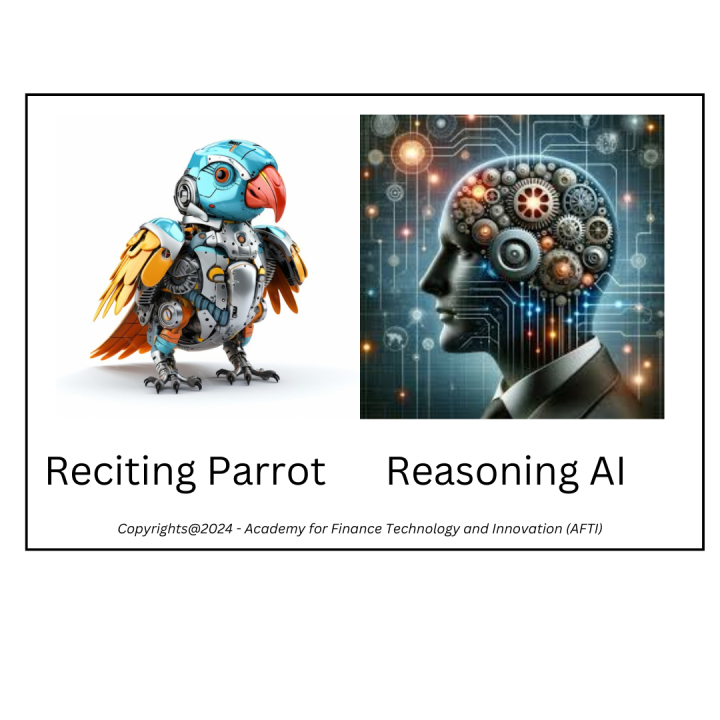
Large Language Models (#LLM) a reciting Parrot or a Reasoning AI Bot ?
 AFTI
AFTI #### Understanding the Limitations:
Researchers at MIT’s CSAIL recently revealed some surprising insights about the true capabilities of large language models (LLMs) like GPT-4 and Claude. While these models excel in familiar tasks, their reasoning abilities are often overestimated. Here’s a closer look at what this means and how we can move forward.
#### Key Findings:
1. Overestimated Reasoning Abilities:
LLMs show impressive performance on tasks they are trained on, but their skills significantly drop in unfamiliar situations. This indicates that their high performance may be more about recalling patterns rather than actual problem-solving.
2. Memorization vs. Reasoning:
These models often rely on memorization of training data instead of developing a robust understanding. Their inability to generalize across different contexts exposes a critical weakness in their design.
3. Task-Specific Limitations:
The study found that LLMs struggle with non-standard tasks, such as non-base-10 arithmetic and altered chess problems. This shows that their adaptability is limited, which is a crucial drawback for real-world applications.
4. Interpretability Challenges:
Understanding how LLMs make decisions remains a challenge. The opaque nature of these models makes it difficult to determine whether they genuinely understand tasks or simply use memorized data.
5. Need for Diverse Testing:
Current testing environments are limited. There’s a need for more diverse and complex scenarios to fully understand and improve these models’ capabilities.
#### Path Forward:
1. Enhance Model Generalization:
Future research should focus on improving the generalization capabilities of LLMs. This involves designing training methods that emphasize understanding over memorization.
2. Diversify Evaluation Metrics:
Expand the range of evaluation metrics and testing environments to include more complex scenarios that mimic real-world applications.
3. Improve Interpretability:
Invest in methods that enhance the interpretability of LLMs. Techniques like attention visualization can provide insights into how these models make decisions.
4. Adaptive Learning Techniques:
Explore adaptive learning techniques that allow models to adjust dynamically to new information and unfamiliar scenarios.
By addressing these critical observations and following the suggested steps, we can make LLMs more effective, reliable, and aligned with real-world needs.
#ArtificialIntelligence #MachineLearning #LLMs #AIResearch #TechInnovation #MITCSAIL #FutureOfAI #AITraining #DigitalTransformation #ResponsibleAI